

How is Chronic Cough Diagnosed?
Diagnosing chronic cough can sometimes be a lengthy and time-consuming process.1,2 Finding the root cause is not always simple because many different health conditions can contribute to chronic cough. Primary care providers (PCPs) play an important role, especially at the beginning, by checking for the most common causes and taking the first steps in evaluation and treatment. However, in some cases, more than one type of healthcare professional (HCP) may be involved in the process. A careful workup by your healthcare team can help identify the cause sooner and help you get the right care more quickly.2
To begin, your HCP will ask detailed questions about your cough, your symptoms, your medical history, and any possible exposures to irritants, such as your work environment, things in the air around you, or recent travel. They will also perform a physical examination and often order a chest X-ray. Certain warning signs may suggest a more serious underlying condition, including coughing up blood, shortness of breath while at rest, a cough that produces a lot of mucus, or repeated pneumonia.
Differential diagnosis
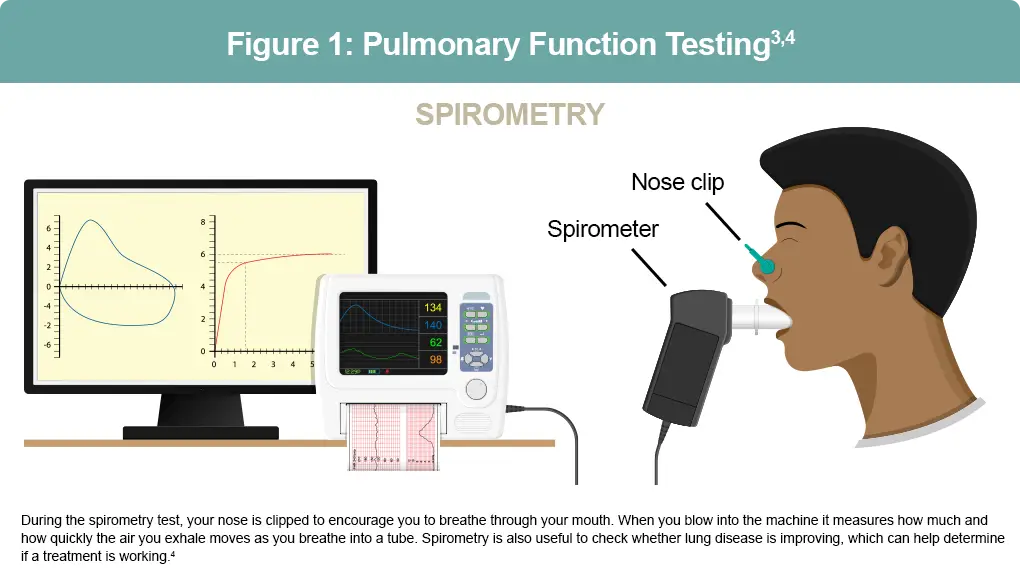
Your HCP will consider and evaluate the different possible causes of chronic cough. This process is called a differential diagnosis. Tests may be used to help rule in or rule out certain conditions. For example, pulmonary function tests (also called spirometry) can assess how well your lungs are working and help identify diseases that affect airflow, such as obstructive (impaired exhalation) or restrictive (impaired inhalation) lung conditions. These conditions include chronic obstructive pulmonary disease (COPD), emphysema (a type of COPD), chronic bronchitis (a type of COPD), asthma, pulmonary fibrosis, and cystic fibrosis.1,3,4 The process of pulmonary function testing is shown in Figure 1.
Other tests may include lab work, additional imaging (eg, sinus scans), and an evaluation for sleep apnea. In some cases, especially when a cough does not improve with initial treatment, your HCP may refer you for tests that can look for signs of airway sensitivity or inflammation that may not be detected on routine exams. For example, some tests assess how reactive your airways are or identify inflammation linked to certain types of asthma. Others may measure substances in your breath that can help guide treatment. Your healthcare provider may also ask you to carry a device called a cough monitor, which measures how often you cough.5
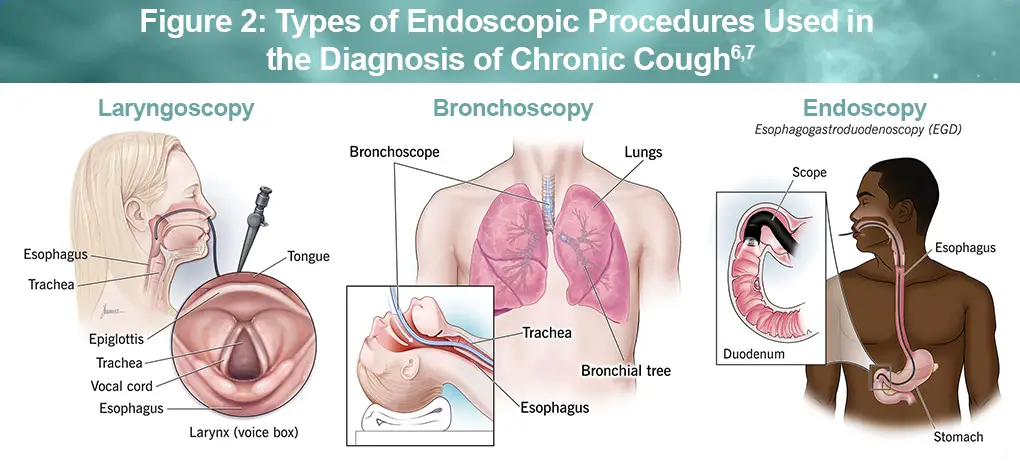
Finally, endoscopic procedures (eg, laryngoscopy, bronchoscopy, or upper endoscopy) may be used to examine the trachea, vocal cords, upper airways, or stomach.¹
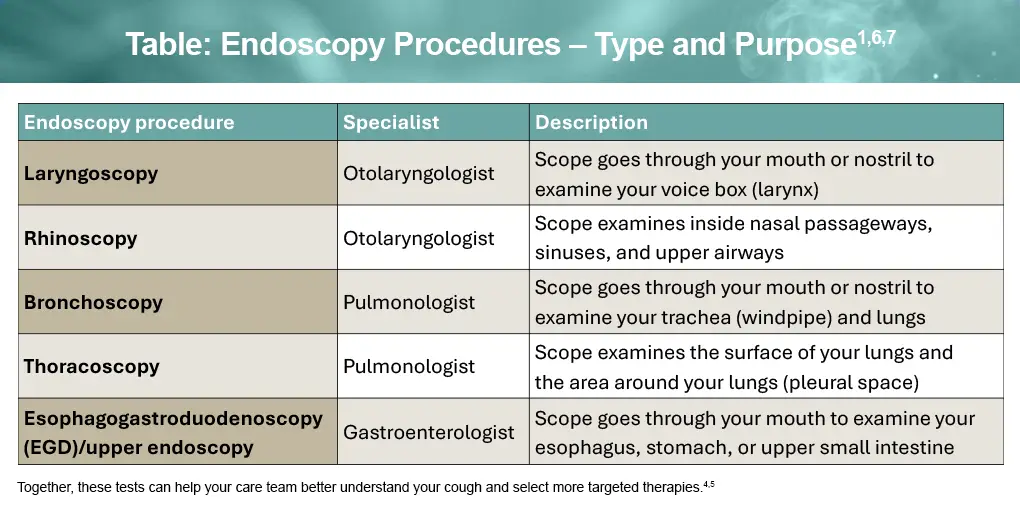
Endoscopes differ based on how they are used. Some are flexible and others are rigid. Some are designed mainly for viewing, while others can collect tissue samples or perform certain treatments. Various types of endoscopic procedures are shown in Figure 2 below. Descriptions of various types of scoping procedures used in the diagnosis of chronic cough are listed in the Table.6,7
The complex process of refractory chronic cough (RCC) diagnosis
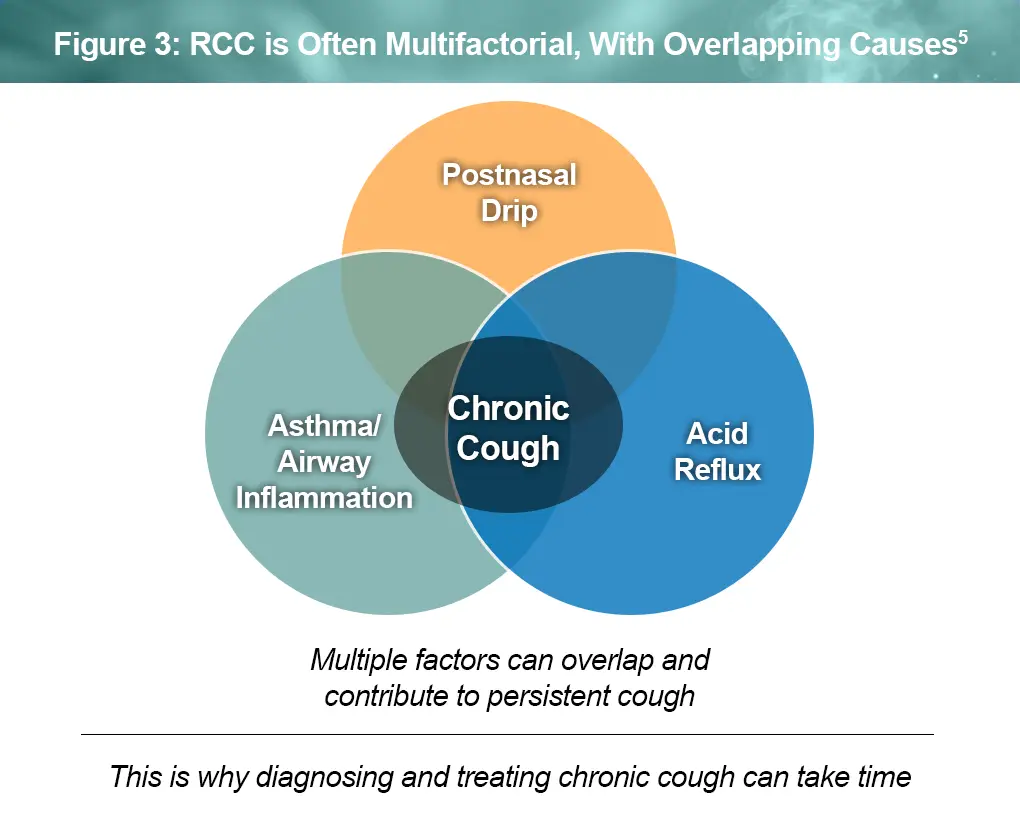
Refractory chronic cough (RCC) can be challenging to diagnose and treat. In many cases, the cause is multifactorial, meaning more than one condition or trigger may be contributing to the cough, as shown in Figure 3.
In some cases, despite thorough evaluation, a clear cause of RCC may not be identified. This is often referred to as unexplained refractory chronic cough (UCC), also known as idiopathic chronic cough. In such cases, effective treatment may require input from multiple specialists or evaluation at a specialized cough center by a cough expert.2,5 Working together, your PCP and specialists—such as a pulmonologist (lung specialist); allergy specialist; ear, nose, and throat specialist (otolaryngologist), and/or gastroenterologist—can collaborate to choose the most effective treatment. This is often referred to as a ‘multidisciplinary’ or ‘interdisciplinary’ team approach to care.1,2 A team-based approach can also help reduce the impact of chronic cough on daily life.1,2
References
- Global Allergy Asthma Patient Platform. Chronic Cough. 2026. https://pauseyourcough.com/en
- Dicpinigaitis PV, Altman KW, Ulger Isci I, et al. Interdisciplinary collaboration in the diagnosis and management of chronic cough: the role and importance of primary care providers. Curr Med Res Opin. 2023;39:1375-1381.
- Efat E. Pulmonary function testing (spirometry). July 2016. https://www.slideshare.net/slideshow/pulmonary-function-testing-spirometry/63692260
- Very Well Health. What to expect from a spirometry test. December 20,2025. https://www.verywellhealth.com/asthma-and-spirometry-200531
- Satia I, Hassan W, McGarvey L, et al. The clinical approach to chronic cough. J Allergy Clin Immunol Pract. 2025;13:454-466.
- Satia I, Wahab M, Kum E, et al. Chronic cough: investigations, management, current and future treatments. Can J Resp Crit Care Sleep Med. 2021;5:404-416.
- Cleveland Clinic. Endoscopy. Last updated 7/12/2023. https://my.clevelandclinic.org/health/diagnostics/25126-endoscopy
All URLs accessed March 20, 2026